


After watching Ragtime, on Broadway, I dried my eyes as much as I could, turned to my husband and said: “The American Dream really is built on the bodies of Black people, isn’t it?... Yeah, I guess so.” That’s what the lesson of the show felt like, to me. And yet, I loved it.
I have listened to the soundtrack repeatedly and done a close reading of the original source material, a novel by the same name by prolific historical fiction author E. L. Doctorow. Reading the book only made me love the show more, giving me a deep appreciation for its insightful examination of American society, the limits of the possible, and how we should think about who America is for.
Then last night, Ragtime won big at last night’s Tony Awards ceremony. It won:
2026 / Best Revival of a Musical
2026 / Best Performance by an Actor in a Leading Role in a Musical
2026 / Best Performance by an Actress in a Leading Role in a Musical
2026 / Best Sound Design of a Musical
I had the pleasure of seeing this show at the Lincoln Center for my birthday, and recently wrote a review of it for Common Good Magazine. I wanted to share it with you all, my wonderful readers, in light of last night’s awards ceremony because its wins are juxtaposed with much online discourse about how unsettled many viewers were after seeing the show, particularly Black audience members. Many felt devastated by the narrative, by the salience of Black pain, and a seemingly “happy” ending that seemed dismissive, or unaware of those things. And while I felt the heaviness of the show, that birthed love.
You can read my review here. I include a synopsis, which I won’t rehash here. What I would like to do instead is share how it resonated with me.
I am a historian specializing in 19th-century Black American history, with a focus on their experiences during the American Civil War, a vantage point that is incredibly important for my own approach and reaction to the show. First, I went in blind. As a lover of musicals, I often can’t help but listen to the soundtrack before seeing the show, read any synopses I can find, and even familiarize myself with supplemental materials. (Yes, for many of you this sounds like turning fun into an assignment, but for me, this is fun!) But Ragtime caught my eye when the now Tony Award winner, Joshua Henry, popped up on my social media feed, delivering one of the most breath-taking arpeggiated phrases of music I’ve heard in a long-time. The now iconic line and trending audio, “Sarah come down to me,” stopped me in my tracks. Not just because his breath control and rich baritone voice are stunning, but because the desperation and pain of his character reached through and touched me in a way that left me feeling I needed to be a witness. I needed to know what animated those notes, what would become of his longing, his hope, his heart.
And I didn’t want a single spoiler. I wanted Henry to show me Coalhouse Walker and his world himself. I wanted to know him and his love, Sarah. I wanted to know how they fit with the rest of the cast. I wanted full immersion—and I got it.
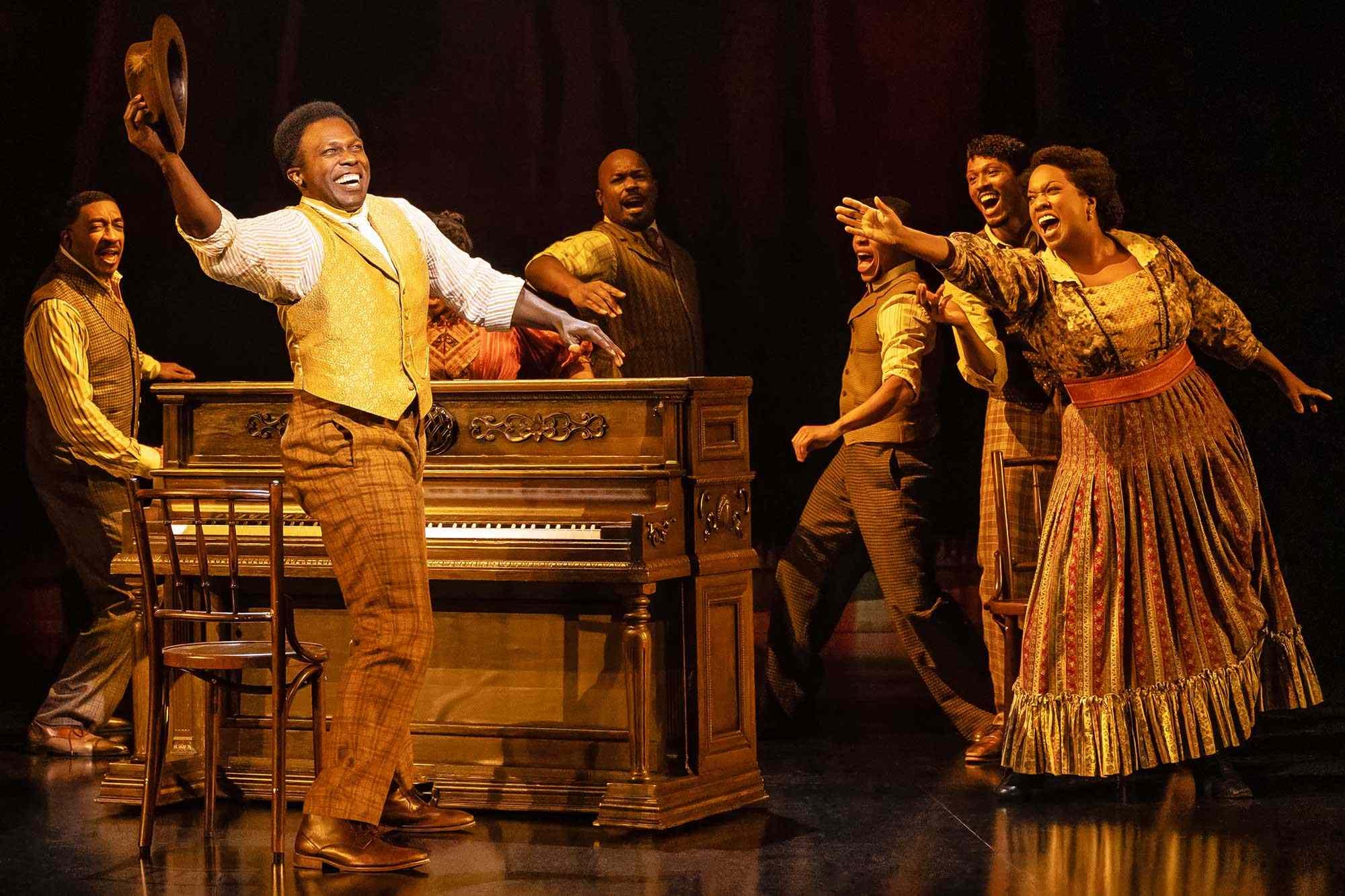
Tony Award Winner Joshua Henry as Coalhouse Walker in Ragtime, accessed via: Entertainment Weekly
The almost 3-hour musical ushers you into the world of change and possibility that marked the beginning of the 20th century, then thrusts you into its harsh realities. The lyrics “an era exploding, a century spinning” accurately describe this world of chaos, loss, and pain, often painted over to highlight the era’s innovations and achievements. And as a historian, I could not help but appreciate the way the show captured the dynamism of the moment while dispelling romanticism and exposing the inequity at the heart of the American system. Besides the incredible performances, you will read in my review that this is part of what I loved.
What felt unsettling for me was how timely it felt in 2026, given the resonance of a story set a century ago, with the social and political climate of today. The familiarity of Coalhouse’s and Sarah’s story, the predictable sketches of injustice, and an ending that illuminates a world that keeps turning no matter the harm occurring all felt necessary. It felt, to me, like unspoken truths being said out loud, like a call not only to act but to witness. And witnessing is difficult.
Witnessing is a position we’re so often forced to occupy in the midst of constant atrocities. Once upon a time, the horrors of war were reduced to still black-and-white images in a newspaper, then to color. Still. Distant. More recently, news cycles consisted of news outlets reusing the same footage, sometimes for days at a time. But in 2026, we witness close-ups of pain and suffering near and far. We watch as systems wield their limbs, doing the bidding of those in power, destroying communities, reducing job opportunities, widening the wealth gap, broadening health disparities. And if you, like me, are a Black woman or any other minoritized identity, we aren’t just watching injustices happen; we’re experiencing it firsthand.
We’re forced to watch it happen to ourselves and those around us, and action feels impossible when it’s most imperative. And while I am usually a call-to-action woman, Ragtime left me with a deep knowing that my justice work, my action, cannot be sustained without sincere witness. Not watching; witness.
Witness is more than watching. It is beholding, being with, letting what you see get under your skin and into you. It is a willingness to grieve and a refusal to allow pain, suffering, and injustice to become commonplace. It says no to the callouses that want to form around my heart, and whispers, “remain soft.” While painful (especially when it is your own story), witness is a crucial starting point for all action. It is courage to tell the truth about what is, and not find a dishonest pathway to comfort.
I love art that tells the truth. But to me, there are two forms of truth. There’s the truth about how things are. There is a truth about how things should be. And Ragtime leaves you squarely in the former, with a whisper about the latter.
The final anthemic song wrecked me. It says:
Go out and tell our story
Let it echo far and wide
Make them hear you
Make them hear you
How Justice was our battle
And how Justice was denied
Make them hear you
Make them hear you
I italicize “make them hear you,” because that is the refrain that left my heart in pieces. Partly because these words speak of the relentlessness required in the work of justice, reminding me of Galatians 6:9, “Do not weary in doing good.” But also because of the heartbreak of what it is to continuously live in a world that has to be forced to care about injustice. A reality in which a mother is forced to not only mourn the murder of her son, but also a verdict that allowed the killer to go free. To witness her wails is not to watch; it is to refuse to be unmoved by them. This is the foundation of justice. It is the foundation of love. It is the beginning of action that is not self-involved, but rooted in compassion. It is how we train our hearts in a good that is not self-righteous but steeped in love of neighbor.
Ragtime is an important and stunning musical and novel. I can say I loved it, despite sobbing through the whole second act, because it told the truth. In a moment when lies and deceit about the past and the present are the norm, telling the truth is precious. So, Ragtime, though painful, is precious.
As always, thank you for reading, and I’d love to hear your thoughts, so please share them in the comments!