


After last week’s overview of the longstanding presence of Africans in Britain and connections between Europe and Africa, it’s time to confront the most pervasive myth on the topic of Black British history. I often hear: “Slavery Didn’t Exist in the UK!” And even last week, I received a comment from someone confused by the reference to the Transatlantic Slave Trade in the context of the history of Black people in Britain. I believe this is the myth that binds all the others. Believing that slavery did not exist on British soil is the founding misinformation that leads people to believe that Black people have not been in the UK very long, and therefore, Black British history and culture are not a thing. This is evidence of the way British education focuses (at least in my youth) on the American narrative of slavery, leaving people looking for a similar historical pattern, experience, and emergent people group. But to understand the histories of minoritized peoples, comparison is often unhelpful as contexts of location-based custom and law fundamentally shape what their experiences looked like. So I encourage you to dive into this overview of the Transatlantic Slave Trade in the British context with a blank slate rather than with comparative assumptions.
The Origin of the Myth and the Truth
Unlike most myths, the myth that slavery did not exist on British soil can be traced directly to its origin. When King Fedeinand and Queen Isabella sent enslaved people to England with their daughter, Catherine of Aragon, the English did not recognize the status of “slave.” This issue had arisen before during the reign of Henry VII, who manumitted an enslaved African named Peo Alvarex, who arrived in England via Portugal. In 1569, 7 years into England’s trading in human flesh, the issue of slavery came up again in court, where a lawyer argued that “England has too pure air for slaves to breathe in.” In 1577, prominent clergyman, William Harrison reinforced and popularized this belief in his book Description of England, where he stated:
“As for slaves and bondmen, we have none; nay such is the privilege of our country by the especial graces of God and the bounty of our princes, that if any come hither from other realms, as soon as they set foot on land, they become as free in condition as their masters, whereby all note of servile bondage is utterly removed from them.”
Historian Miranda Kaufmann argues that, though hyperbolic and flattering, Harrison’s theory had a “ring of truth.” This is because, indeed, many African enslaved people managed to secure freedom in England, but more importantly, England did not have legislation surrounding slavery. Unlike France and Portugal, which had “Black Codes” governing the possibilities of what life could look like for the enslaved on their soil and colonies, Britain had no such laws (on British soil). In 16th-century England, slavery was neither legal nor illegal; it was a legally invisible status. However, the absence of law did not mean that Africans did not occupy slave status and suffer such treatment across time. In practice, slavery very much existed on British soil. Kaufmann evidences that Africans were continuously referred to as “slaves” in the historical record, were bought and sold by English people, subjected to brutal whippings and other physical punishments, and were not paid for their labor. Each of these is a hallmark of racial slavery across Europe and the New World in the 16th through 19th centuries.
Additionally, there is the misunderstood story of Queen Elizabeth I’s supposed “expulsion” of Africans from Britain in 1596, which has led many to believe, teach, and share that Black people did not reside there afterwards. The truth of this historical moment is that Queen Elizabeth’s Privy Council “issued a limited license” to Captain Caspar Van Senden, a merchant, to only permit him to “transport individuals out of England with their masters’ consent.” In reality, Senden did not secure the consent of any English enslavers, demonstrating their commitment to retaining enslaved labor on English soil.
This lack of legislation and misrepresentations of historical events are the root causes of the persistent myth that slavery never existed on British soil. But in reality, this points to the invisibility of Black experiences on English soil and the way in which memory (how we discuss and memorialize our nation’s stories) functioned in the 16th century. The original historical narrative entirely obfuscates Black presence and life in England. Harrison’s mythological depiction of England’s air as so thoroughly infused with freedom that slavery could not exist, combined with the lack of legislation, and the myth of “African expulsion,” has come to define the common understanding of Britain’s relationship with slavery on its soil even til today.
The Early Manifestations of Slavery on British Soil
What is true is the varied experiences of Black people in Tudor England and earlier. As we have learned so far, connections and migration existed between Africa and Britain before the Transatlantic Slave Trade. Ira Berlin, a historian of American slavery, argued that race is not only a social construct, but also a historical one. Race as a historical construct means that “blackness” and “whiteness” held different meanings in different moments in time. This is especially clear in Medieval Britain, where Africa connoted wealth and prosperity, and Africans could be servants and workers in the Royal Court (John Blanke), merchant sailors, army men, or enslaved. Although there is evidence of racialization happening as early as the 13th century, historian Marianne Kaufmann highlights that, before the Transatlantic Slave Trade, skillset, religion, and status often defined the experiences of Africans in Britain more than racial categories. Nonetheless, parish records, correspondence, and legal records demonstrate that by the 16th century, people of African descent populated London and seaports in the south of England in small clusters. The majority of these Black Tudors lived and worked as domestic servants, but there is a lack of clarity surrounding their status as free or enslaved people.
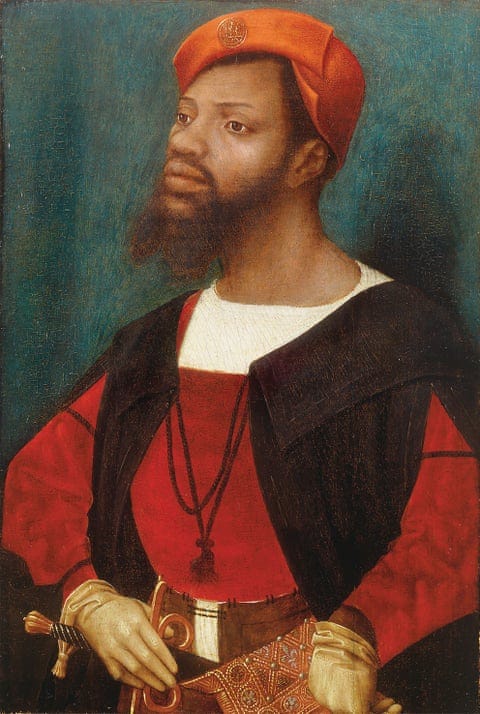
Portrait of a Moor by Jan Mostaert, early 16th century, accessed via: The Guardian
Not only was race a flexible category in mid-16th-century England, “slave” was too. One clear example of this early flexibility can be seen in the arrival of five West African enslaved men in 1555, on the ship of English trader John Lok. In a travel account of Lok’s voyage, it is reported that the merchants returned to England with ivory, pepper, gold, and “certaine blacke slaves.” Although they were “slaves,” in England, they functioned as “intermediaries and translators for future expeditions,” which the English hoped to become more lucrative. The English learned this use of Africans as intermediaries from the Portuguese, who dominated trade with African royalty and were 70 years deep into the slave trade before England had even begun. Brought from the coasts of Ghana, we know little about the men. Richard Hakluyt described them as “tall and strong men” who “wel agree with our meates and drinks,” but with whom “the colde and moyste aire doth somewhat offend them.” Unexpectedly (to our 21st-century understandings), the English returned the five men to their homes in Ghana after only a few months of service in London. The traders reported that upon the men’s return, their families and kin wept for joy, a reaction that is imaginable in the context of the Transatlantic Slave Trade, which had trained Africans to expect never to see loved ones again.
While this tells of early flexibility of enslavement in Britain, historian David Olusoga argues that it set the stage for English traders to establish a slave trading stronghold in competition with the Portuguese. As such, this flexibility gave way to a racialized rigidity, 7 years later, with the first voyage of a slave ship led by Captain John Hawkins.
Come back on Wednesday for part 2, where we will examine Britain’s deep commitment to the Transatlantic Slave Trade in the 17th and 18th centuries.