


The belief that Black people have not been in the UK for very long is a persistent myth that centers on the Windrush generation (which we will examine in the next few weeks). It makes sense that this has become the centerpiece of the narrative about Black people in the UK because it is perhaps the single moment we can point to, in the 20th century, where thousands of Black people arrived at once. It is also a moment where Black people arrived, invited by the Crown, meaning we have dense records of their presence, clear dates of arrival, definitive numbers, and a subsequent descendant population. Clarity and ease of access to historical sources is a common way in which stories get filtered out. The historical record depends upon systematised records held by individuals, local municipalities. States, and nations, meaning, in the case of Black and Brown histories in the global North (and also the poor), the stories that are easiest to tell are those dependent upon what those powers saw fit to archive and memorialize.
Doing the history of marginalized people requires that we dig a bit deeper. That we piece together scraps of history that are threads of a larger tapestry that we may not see in full and clear view. This, again, is why critical mass cannot be the only way we define Black British history, as we will never fully know the numbers of Black people who lived and built homes in the UK across time. Though records are sparse, we do have evidence of Black people and Africans present in England and Scotland as early as the 3rd century AD! So let’s start there.
FYI: I don’t want this to be a 10-hour read, so this is a whirlwind introduction to Black history in each era. I have also split this into two parts, and part 2 will be posted tomorrow.
Romans in England
Historical records in the North of England show the presence of Africans as part of the Roman rule of Britain as early as the 3rd century AD. The famous Hadrian’s Wall marks the most northern part of the Roman Empire, which stretched all the way to North Africa, and from tomb inscriptions and military records, it is clear that several North Africans came with Rome as part of the army. Likely hailing from Libya, Tunisia, and Algeria, all of which were under Roman rule for 400 years, many of these soldiers would have traveled to the UK with their families in tow, due to both distance and the permanence of the post. Thus, while North African men served as Roman soldiers guarding and protecting English borders, their families settled in nearby towns, raising generations there.
One way this is known is through the military records of Roman Emperor Marcus Aurelius, who ruled Britain (and the whole Roman Empire) for 19 years. Known as the Numerus Maurorum Aurelianorum, North African soldiers served in this auxiliary unit of the Roman army, stationed in Britain along Hadrian’s Wall. While North Africans are not phenotypically considered Black, this is evidence of African contact with Britain long before the dawn of the modern world, and even before Britain existed as a geographical concept. Another piece of evidence comes from the inscriptions found on an excavated altar stone, which archeologists have determined was part of the Roman fort Aballava in Cumbria. The inscription includes a dedication to the god Jupiter and records the presence of what the writer called “Aurelian Moors.”
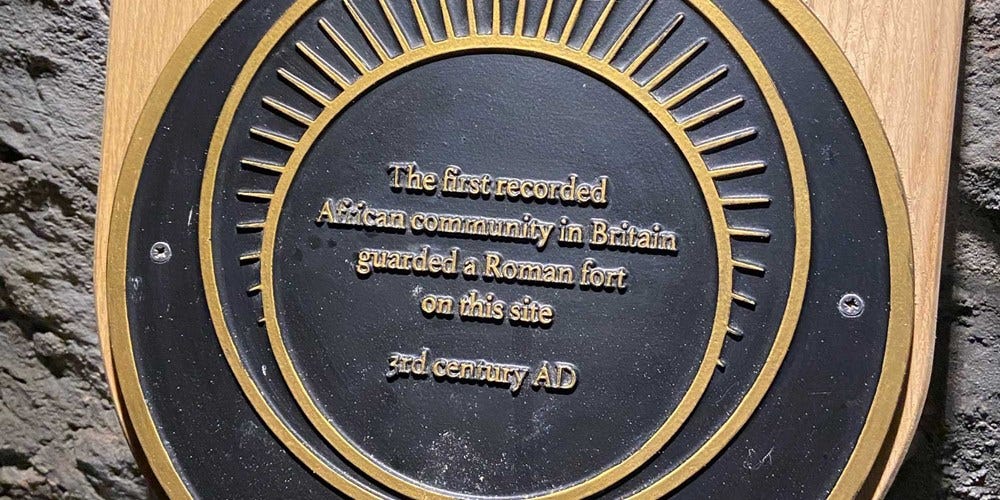
Plaque commemorating the African Regiment stationed at Ford Aballava on Hadrian’s Wall in the 3rd Century, accessed via: Historic England.
As archeology and forensic science have made strides, more and more histories are becoming accessible. The exhumation of over 200 bodies found in York in the mid-20th century served as another key discovery in the history of Roman-era people of African descent in England. Among the skeletons exhumed were several bodies that have been proven to be those of Black Africans. Initially studied by archeologists in the 1980s, who based this assertion on the proportions of the skeletal remains, their conclusions were verified thirty years later by forensic science. This technology also helped identify the “Ivory Bangle Lady,” a third-century African woman who lived in the North of England. Archeologists encountered her remains buried in a stone sarcophagus in 1901, finding that she had been buried with an inscribed bone which reads: “Hail sister, may you live in God.” This suggests the woman was likely a Christian. Other trinkets accompanied her remains, including “blue marbled glass beads, fragments of five bone bracelets, silver and bronze lockets, two yellow glass earrings, two marbled glass beads, a small round glass mirror, and a blue glass perfume bottle.” Each of these items indicates that she was an upper-class woman in Roman England. It was not until 2009 that radio-isotope analysis could be done on the body, and it was confirmed that she was likely of mixed racial ancestry, likely North African.


Images of some of the recovered items in the sarcophagus of “The Ivory Bangle Lady,” accessed via Yorkshire Museum.
There are countless other examples of figures like this, and their stories are significant because British history often frames first contact between Africans and the UK as a result of British efforts to reach Africa, boasting the seafaring prowess of the Tudor Empire. But evidence of North Africans in Roman
ngland completely uproots this narrative, demonstrating the mobility of Africans across the Roman Empire.
Medieval Racialization
Interestingly, there is a palpable historical silence between the Roman era and the 13th century, but, as we have already established, silence simply means stories as yet untold, not strictly absence. This is particularly evident in the discussions of racialization that take place in Britain and across Europe in the 13th century. Discussion of Blackness, or “Africanaity,” and its meaning among Europeans connotes that interactions had continued throughout those long years with a limited historical record. How else would questions about race be so prevalent? What else could be the cause of discussions around interracial marriage in Britain and Germany?
The debate around racialization in the context of the United States typically centers on the Transatlantic Slave Trade, with historians long debating whether the Slave Trade created race or whether race created the slave trade. Yet, European history reveals that this process began over 200 years before the inauguration of the Transatlantic Slave Trade. We can see the beginnings of racialization as early as the 13th century. Africans and Europeans had been in enough contact for racialization to become a subfield of medical study. Physicians expressed a curiosity about Black women’s bodies, desiring to validate the widespread belief that black women produced superior breast milk. The notion derived from Aristotle’s belief in the connections between menstrual blood and heat, and physicians believed that black women’s milk had the most nutrients. In Paris, medical discourse asserted Black women’s hypersexuality as a consequence of the hotter temperatures of their native climates.
Theology played a part in the process of racialization, too. In 1215, English theologian Thomas of Chobham sought to regulate the institution of marriage between a white man and a white woman. It was believed by he, and many other European clergy, that Africans were hypersexual, the relations between white men and black women were ultimately part of the “private sphere” and thus could not be governed, or sanctified by, the institution of marriage. As historian Olivette Otele argues, “these debates were not exempt from shame, confusion, and morbid fascination,” resulting in a “firm set of widely accepted views” that took root in the 13th century. As you may have noticed, much of this racialization is gendered. Theologians and philosophers demonized foreign women, particularly Black women, who worshipped other Gods, as “dangerous to family structures and social order,” particularly because of the responsibility of children and the home women assumed. Notions of race shaped notions of gender before the explosion of modern slavery across the Old and New World.
The idea of Africa burned bright in the medieval European and British imagination. This is evident in medieval English maps and art. In the famous medieval map of the world called the Mappa Mundi, Africa is depicted alongside Europe and Asia, as the three continents of Christendom. More specifically, the map highlights Ethiopia as civilized and majestic, due to its longstanding Christian religious heritage, while the rest of Africa is imagined as a place of mythical beasts and seemingly animal-human and plant-human hybrids. Nonetheless, the map illuminates the interconnectedness of these continents, European awareness of Africa and Asia, and the long history of mobility and migration between continents. In the Early Modern imagination, Africa existed as a site of potential wealth.
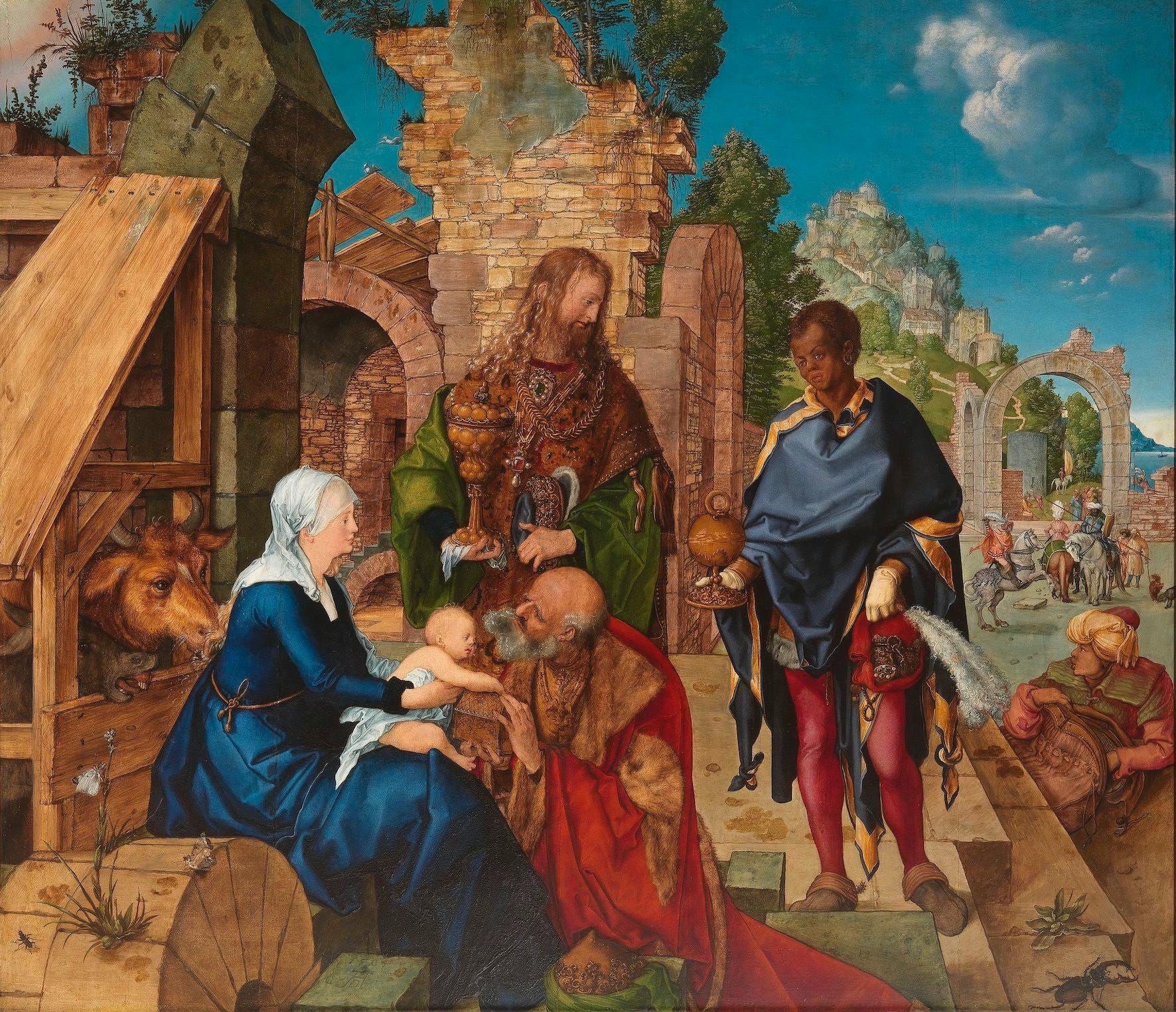
Adoration of the Magi, by Albrecht Dürer (Nuremberg 1471 - 1528), accessed via: Uffizi Gallery
Interestingly, the most vivid imaginaries of Africa came in conceptions of the Christian story of Jesus’ birth. Throughout the Middle Ages and Tudor England, an understanding of the three wise men, who visited Jesus in Bethlehem to offer gifts, emerged, making one of them African and eventually sub-Saharan in appearance. Though nameless in the Bible, the Church imbued the three wise men with the geographical history and politics of the day, one that celebrated a three-pronged Christendom, in Asia, Africa, and Europe. As such, many altarpieces from this time depict one of the three Magi as African, both in skintone and features. Historians of the era argue that part of the symbolism of an African Magi is the potential wealth of Africa and its ability to enrich Christendom. This vision of Africa as a place of riches went on to fuel England and Europe’s dogged pursuit of the Transatlantic Slave Trade and colonization of Africa.
Come back tomorrow for part 2 where we will explore Black Tudors through to World War One!