


It’s Black History Month, and the theme this year is “commemorations.” Indeed, 2026 is a big year for commemoration in America. On July 4th, the nation will celebrate 250 years since the signing of the Declaration of Independence, a document that has shaped American identity and imagination ever since. Lesser known may be that 2026 is also the 100th anniversary of Black History Month! To employ the theme of “commemorations,” the Association for the Study of African American Life and History (ASALH), the founding organization, is encouraging us to “explore the impact and meaning of Black history and life commemorations in transforming the status of Black peoples in the modern world.” So for the next four weeks, I will be writing and sharing essays on how Black history has shaped Black advancement, and even how it has changed me as a part of the Black diaspora.
In this social and political moment, some are questioning the value of this long-standing heritage month, and countless others are afraid that this year may be our last one based on the rollbacks and EOs we have seen in the past year. I believe both of these perspectives require a deeper understanding of the history of Black History Month, its founders, its origins, and the way it became a nationally celebrated heritage month. So before we dive into commemorations, we must start there. Considering the history of Black History Month may feel meta, but it is a worthy starting point for our learning and celebrations because, as you will see, Black History Month itself is a site of remembrance.
Buckle in and feel free to listen to this essay, as it’s going to be a long synoptic dive in 5 parts:
History of the Founder: Carter G. Woodson
The Origins of the Study of Black History
The Origins of Black History Month
Black History Month Becomes Official
Black History Month Now
Let’s dive in.
Meet the Founder: Carter G. Woodson
Before forging pathways for Black history, Carter Goodwin Woodson forged his own from a patchy education in his youth to completion of his doctorate at Harvard. Born in December 1875 in rural Virginia to formerly enslaved parents, Woodson’s access to education was limited. In his youth, the public schools had five-month terms, but as he worked alongside his parents on the farm, he only attended school on the days his parents did not need his help (typically during periods of rain or snow). Nonetheless, Woodson took his education seriously, quickly out-pacing his classmates. Woodson set his sights on college, but did not start high school until the age of 20, as he worked in coal mines alongside his father.
In his youth, Woodson’s father instilled him with dignity and self-respect, uninhibited by his own illiteracy, and asserted equality with whites as an indisputable truth. Woodson’s time in the mines further refined these principles and priorities, cultivating a dedication to the learning of the working class. Surrounded by miners who were hard-working and longed to learn to read and write, Woodson developed a deep respect for his co-workers, young and old, and worked hard teach them how to read and write. In particular, Woodson recorded the influence of a Black Civil War veteran he encountered who strove to learn to read, collecting books and subscribing to many newspapers long before he could. Simultaneously, Woodson encountered a white miner who claimed to be a devout Christian while also bragging about participating in the lynching of four Black men. Woodson likened this stance to the pro-slavery religious white people of the antebellum era, and felt a deep disdain for such “unchristian” principles held by most white people at the time. Hatred for this hypocrisy marked Woodson’s career, serving as the foundation for his staunch critique of Black churches that were willing to partner with segregationist institutions, like the YMCA, that he became known for decades later.
Carter G. Woodson, Founder of ASALH and Black History Month, accessed via: Black Past
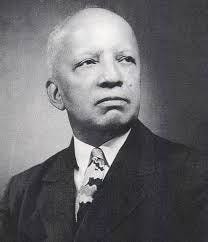
Carter G. Woodson, accessed via: BlackPast
Although Woodson began high school late, he obtained his diploma within one year, moving away to attend Berea College in Kentucky and Lincoln University in Pennsylvania. For unknown reasons, Woodson interrupted his studies to return to West Virginia for work as a high school teacher, while simultaneously serving as a Sunday school teacher and president of the board of deacons at Winona’s First Baptist Church. By 1900, Woodson became principal of Douglass High School, and by 1903, he completed his degree at Berea. After graduating, he went on to travel to the Philippines as an education superintendent for the U.S government, eager to learn more about how education methods could be improved for Black people. After returning from extensive travels through Asia and Europe, Woodson enrolled in a master’s program in European History at the University of Chicago. In 1912, he became the second Black American to obtain a PhD (in History) from Harvard University, following in the path of W.E.B DuBois. His long and illustrious career culminated in becoming Dean of the College of Arts and Sciences at Howard University.
Exploring his other major achievements leads us to the origins of Black History as a field of study and Black History Month, so let’s dive into that.
The Origins of the Study of Black History
After graduating, Woodson became increasingly determined to create spaces for Black scholars and Black history. In 1915, Woodson, familiar with Chicago after attending the University of Chicago, returned to the city for the celebrations of the 50th anniversary of state-sponsored emancipation. The streets bustled with over 10,000 Black people who had come to remember their long journey to freedom and celebrate the progress made since slavery’s end. Part of the celebrations included Woodson’s very own Black history exhibit, which was met with vast interest. The celebrations lasted three weeks, bringing more and more curious patrons to his exhibit, further inspiring Woodson to determine more ways Black life and history could be celebrated and studied.
Racial barriers that shaped Woodson’s experiences of academia also influenced Woodson’s determination to create space for Black history. Despite paying dues for the American Historical Association, the organisation barred Woodson and his colleagues from attending the annual conference. He also lamented that historians had little interest in Black history, arguing that Black achievements and contributions were “overlooked, ignored, and even suppressed by the writers of history textbooks and the teachers who use them.” Woodson understood that he and his Black colleagues needed their own institutions to study and preserve Black history, and Chicago’s emancipation anniversary celebrations simply confirmed the broader appeal and interest.
ASALH logo. ASALH is a vibrant affiliate organization for scholars of many disciplines who focus on Black American History, but also those who study the African diaspora more broadly. Accessed vial: ASALH
Thus, in fall 1915, Woodson and several others formed the Association for the Study of Negro Life and History, which we now know as the Association for the Study of African American Life and History (ASALH). The founders stated its mission was the scientific study of the “neglected aspects of Negro life and history.” Shortly after its inception, the organization created the Journal of Negro History, which persists to this day as the Journal of African American History. In an article entitled “Negro Life and History in Our Schools,” published in the journal in 1919, Woodson enunciated the problem with the field of history and its consideration of Black people thus far:
The Negro… has unfortunately been for some time a negligible factor in the thought of most historians, except to be mentioned only to be condemned. So far as the history of the Negro is concerned, moreover, the field has been for some time left largely to those sympathetically inclined and lacking scientific training. Not only have historians of our day failed to write books on the Negro,but this history has not been generally dignified with certain brief sketches as constitute the articles appearing in the historical magazines.
Indeed, prominent historians of the time promulgated Lost Cause ideology and romanticized versions of slavery that asserted it as a benign institution beneficial for Black people and freedom as detrimental for them and dangerous for the white population. Examinations of Reconstruction (the post-emancipation era in the South til 1877) concluded it a failure, as a result of Black inferiority, despite the gains made by formerly enslaved people and free Black communities across the South, in both politics and education. These studies ignored the state’s willful expansion of imprisonable crimes and countless other systems put in place to limit the upward mobility of Black people, and obfuscated the crippling terror of racial violence. Woodson and his colleagues pushed back on these narratives through the journal, publishing thoroughly researched pieces on everything from Black life across different American regions, Latin America, and the Caribbean (illuminating its diasporic considerations from its inception), to Black religion and politics.
The Origins of Black History Month
It was out of ASNLH and the journal that Black History Month was born. Woodson’s commitment to the study of Black history combined with a determination for it to be showcased for public engagement. He encouraged Black fraternities and other Black civic organizations to highlight the research of their members, promoting Black excellence and knowledge of Black achievements. The first iteration of Black history celebrations came from Omega Psi Phi, a Black fraternity of which Woodson was a member, which launched “Negro History and Literature Week” in 1924. Eventually, the fraternity renamed the celebrations “Negro Achievement Week.” Though the celebrations were far-reaching, Woodson desired a greater community impact and decided that ASNLH should pioneer the program. To Woodson, these celebrations were an opportunity to “go back to that beautiful history” and to allow it “to inspire us to greater achievements.” And so, “Negro History Week” began in February 1926.
People today often ask: “Why February? Why not the month of June, when we already celebrate Juneteenth, and why the shortest month of the year?!” But Woodson chose February strategically, as Black communities already held meaningful commemorations during that month. First, February is the chosen birth month of Frederick Douglass (14th), the former slave and abolitionist activist, and Abraham Lincoln (12th), whom many (at the time) deemed “The Great Emancipator.” These birthdays had become sites of commemoration for Black communities across the nation, and so these longstanding traditions also informed Woodson’s choice. From Lincoln’s assassination onwards, Black communities held celebrations in honor of the President slain for his antislavery efforts. Similarly, Frederick Douglass’ birthday had become a fixture in the Black calendar since the mid 1890s. Thus, Woodson built “Negro History Week” around the longstanding traditions celebrating figures central to the Black past and future. Woodson chose his timing strategically, using “Negro History Week” to nudge celebrants away from their celebrations of “great men,” to focus on broader achievements of the Black community as a whole. In fact, Woodson disliked the commemorations of both Lincoln and Douglass because he believed most people did not know enough about either of them to celebrate them. At the time, in the hopes of making it accessible and accepted, he argued that the week was an opportunity to extend their study of Black history, rather than a burden to create new traditions.
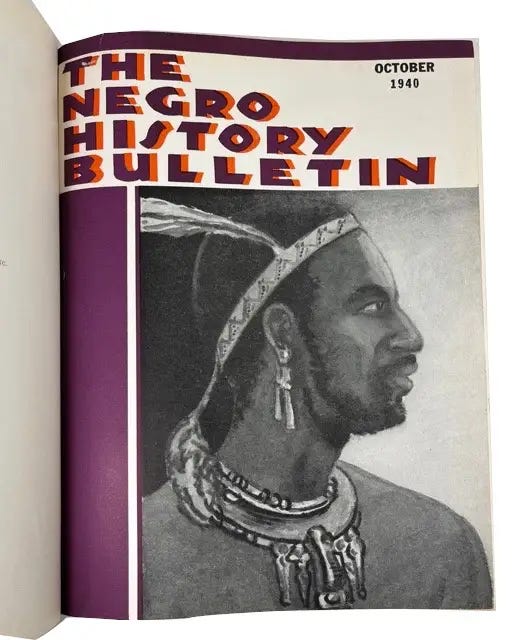
The Negro History Bulletin, Vol IV (October 1940- June 1941), accessed via: McBlain Books
As we know, Woodson far underestimated the traditions that would come out of “Negro History Week.” The late 1920s, fueled by the burgeoning “New Negro” (a generation of Black Americans defined by racial pride, consciousness, and hope), saw the explosion of the heritage week across the nation. Schools asked for teaching materials, and public exhibits emerged. ASNLH struggled to keep up with the demand, shocking Woodson and the founders, and necessitating the opening of ASNLH chapters across the country. Even progressive white people expressed interest and began joining celebrations. As the heritage month grew in popularity, Woodson worried about the “intellectual charlatans” who took advantage of public interest by misrepresenting their credentials and speaking to students who had more knowledge than them. But the organization had created something far beyond their control, and could only continue to share materials, while it became more commercialized and (in Woodson’s opinion) trivialized. Its sustained popularity birthed the idea of an annual theme, and in 1937, via the “Negro History Bulletin,” Woodson began popularizing the theme nationwide, distributing the bulletin through burgeoning Black history clubs.
Black History Month Becomes Official
Throughout the mid-20th century, “Negro History Week” continued to grow. Woodson assumed that the celebrations would eventually fade, but, instead, their inception inspired countless people across the nation to expand the study of Black history in schools and in the public square. As early as the 1940s, many communities across the country began to shift towards month-long celebrations of Black history. By the 1960s, spurred by the Civil Rights Movement and the beginnings of African American History and Studies as a formalized field of study at Universities, month-long celebrations became the norm. It was also around this time that the name changed from “Negro History Month” to “Black History Month,” reflecting the preferred language of younger generations and their interest in taking up the mantle for the celebration and preservation of Black History. Eventually, the founding association affirmed the language shift and the month-long celebrations by institutionalizing these changes.
Black History Month has been acknowledged by sitting Presidents since the 1970s, no matter their party. Sixty years into private celebrations of Black History Month, the US government formally recognized National Black History Month in 1976 by passing Public Law 94-479, which encouraged “our Nation’s public schools, institutions and knowledge of the many contributions of Black Americans to our country and the world.” Much like many historical laws regarding Black Americans, this congressional law affirmed and supported a national expansion that had been underway for decades. Nonetheless, this was a crucial step by Congress to protect the practice and celebration of Black History Month in the public square nationwide. The state did not create the holiday, but it did give legal underpinnings that would require legislative change to undo, a truth that should be a balm to those worried about any potential attempts to dismantle it.
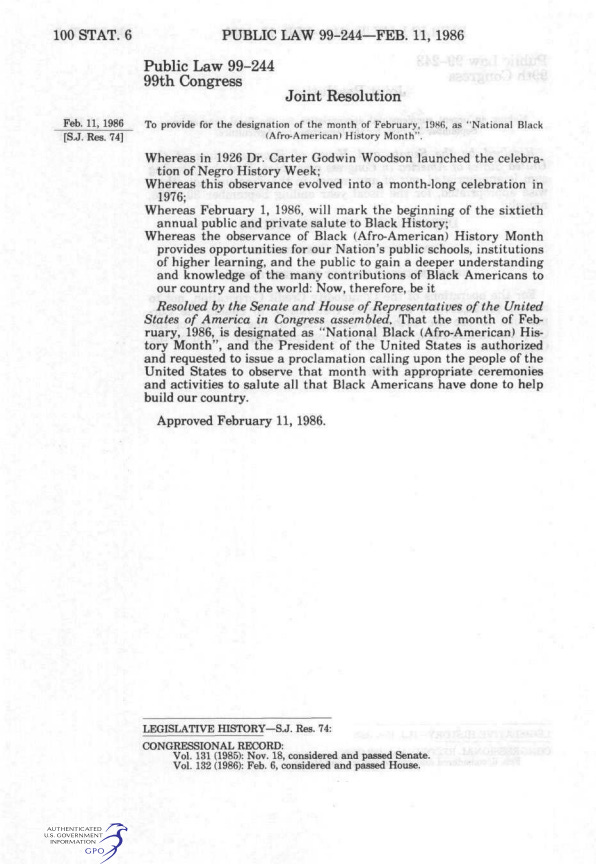
Public Law 99-44- February 11, 1986, 99th Congress, accessed via: Govinfo
Black History Month Now
100 years after its founding, in our contemporary moment, many have issues with Black History Month in its current form. First, people lament the relegation of Black History to one month per year, preferring that teachers and curricula integrate Black history into broader American History. Indeed, Black History Month has suffered the detrimental consequences of institutionalization. Many see the month as a reason to confine Black history coverage of any kind to that month only, rather than seeing it as an opportunity to emphasize and remember the specific achievements and contributions of Black Americans. Indeed, as a historian who specializes in Black History within American History, I am consistently astounded by the lack of integration that persists even within academic circles, let alone in the public. “Black History is American History” is a cry of many who long for the integration of the two, not just for the sake of inclusion, but for the purposes of telling the whole truth of the American past. Indeed, Black history is indivisible from American history, from the horrors to the heroes; two are one. However, despite my own hopes for a thoroughly integrated version of the American story, I still believe in the essentiality of Black History Month. To me, as it was to Woodson and the other founders, Black History Month offers us an opportunity to celebrate those who are still not seen as founders, inventors, creators. Integrative history allows for Black America’s threads in the broader tapestry to be seen, as well as the atrocities perpetrated to be unignorable. But Black History Month presents a sacred opportunity to honor and remember those who were not honored in their time.
Second, the institutionalization of Black history by the Federal government has created some amnesia around its origins. There is a common misconception that the state chose the month and dictated its parameters; few people know that Black History Month is the outgrowth of grassroots Black scholarly labor, activism, and creativity. This is why I am starting this month’s “commemorations” by commemorating its history. Black History Month becomes more precious when we understand its origins, the countless people who have fought for Black stories to be told, and the feat that it is to be so far-reaching that the Federal government had to recognize it.
Black History Month is a Site of Remembrance
Learning the rich history of Black History Month has transformed my understanding of this month, from merely an opportunity, a vehicle by which we can learn more, into a deep appreciation of it as a site of remembrance. Indeed, learning Black History is important, but learning is only the beginning. When we learn, we can remember. And the act of remembrance changes us. Remembrance of not only the fight to create Black History and its commemorations, but also the curiosity, self-affirmation, and determination illuminated by its instant popularity, allows us to situate ourselves in those same convictions. To remember is not to simply recall, but instead to glean the truths from history and make them the very foundation upon which we stand. And we stand on the shoulders of giants.
Talk to Me
After that whirlwind introduction, I hope you, too, can see Black History Month as a site of remembrance and celebration. I would love to know: what did you know about the origins of Black History Month? And, what do you believe is the significance of Black History Month today? Let me know your thoughts by commenting below.
Come back next week, when we’ll be going back into the 19th century to learn how practicing Black History changed the future of the enslaved.
References
Dagbovie, Pero Gaglo. “Carter G. Woodson (1875-1950).” Black Past. January 18, 2007. Accessed via: Black Past
Morris, Burnis E. “Carter G. Woodson: The Early Years, 1875-1903.” Accessed via: ASALH.
Carter G. Woodson. Accessed via: NAACP
Woodson, C. G. “Negro Life and History in Our Schools.” The Journal of Negro History 4, no. 3 (1919): 273–80. Accessed via: JSTOR.