


In this, the first full week of Black History Month UK, we’re diving into 18th-century London. Home to an estimated 12,000 -15,000 Black people from across the world by the 1760s, this population was a small but felt presence in the 1700s. So much so, newspapers grossly exaggerated their numbers, doubling these estimates, and the government repeatedly threatened total expulsion of Black residents throughout the century, framing Black life of all ranks with fear. S.I. Martin’s historical fiction novel Incomparable World captures this fear, highlighting the fragility and fractured nature of Black life in London, while illuminating Black ingenuity that facilitated their survival.
The World of Incomparable World
Incomparable World unearths the untold stories of Black American soldiers who fought for the British during the Revolutionary War in exchange for their freedom on British soil. For those who may be unfamiliar, in 1775, John Murray, the Earl of Dunmore, and loyalist governor of Virginia, issued a decree offering freedom to any enslaved people who abandoned patriot slave owners and joined the British army.
I do hereby further declare all indented servants, Negroes, or others (appertaining to rebels) free, that are able and willing to bear arms, they joining his Majesty’s troops, as soon as may be, for the more speedily reducing this colony to a proper sense of their duty, to his Majesty’s crown and dignity.
Within the month, over 300 Black men registered as soldiers in the “Royal Ethiopian Regiment,” and that number quickly grew to 800. Eventually, throughout the course of the war, an estimated 15,000 enslaved men cast their lots in with the British and fought for the Crown. Even though this was a limited number of soldiers, it is estimated that over 100,000 enslaved people (¼ of the total number across all 13 colonies) escaped to British lines over the course of the American Revolution in hopes of securing their freedom. After the war, those who served and those who escaped to British lines were strewn far and wide. Roughly 3,000 were sent to Nova Scotia, where they received freedom and land grants to start new lives. Several thousand were sent to British Sierra Leone, while others were sent to Britain and the Caribbean. The majority, though, including those who fought for the US under the same promise, were left enslaved. Incomparable World merges fictionalized Black American soldiers with the historical reality of the thousands who were taken “to exile in London.” The promise of freedom quickly revealed itself to be precisely that, an exile. As the narrator says, “none of the black fighters could have imagined the so-called freedom to which they would be doomed.”
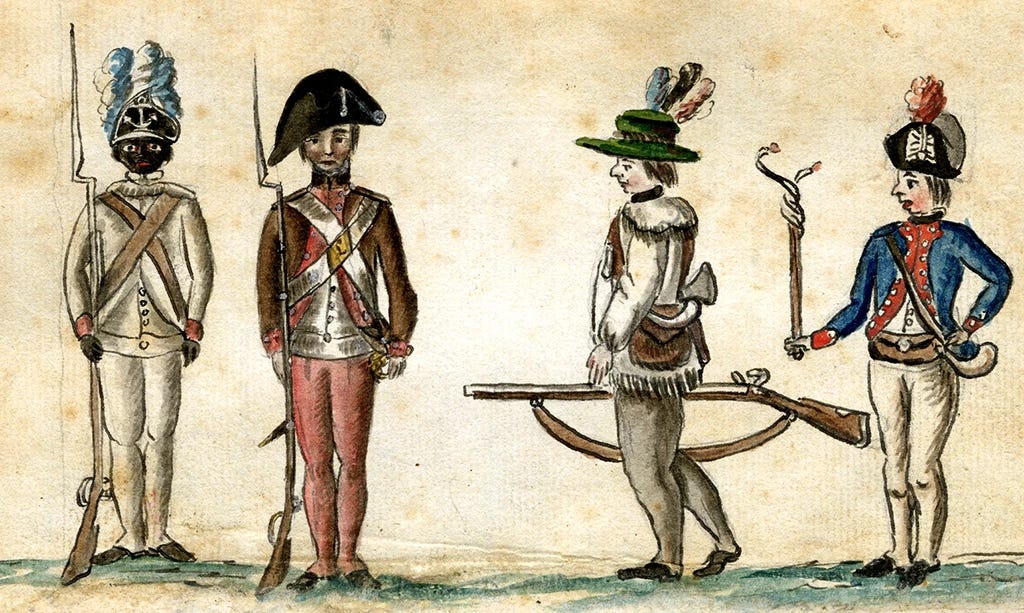
Four soldiers from the siege of Yorktown in 1781. The African American soldier on the left is a member of the Rhode Island Regiment that served in the Willetts Oswego expedition. A historic watercolor by Jean-Baptiste-Antoine DeVerger. Accessed via: NPS
The book begins in 1786, when we meet three Black American former soldiers as they build new lives as freedmen in London, England. Buckram (the protagonist), recently released from a two-year imprisonment, tries to find his feet in freedom again; trickster and man about town Georgie George is always ten steps ahead in another scheme to better his and his friends’ lot; and Willie, an aspiring actor, is saving to purchase the freedom of his wife and children back on US soil. In a way, these men are old friends, and in another, they are simply bound together by circumstance and shared fates. While these are fictionalized characters, Martin leads them to cross paths with known figures in Black British history like Ottobah Cugano and Olaudah Equiano, and shapes their lives through the ramifications of real historical events like the Gordon Riots of 1780.
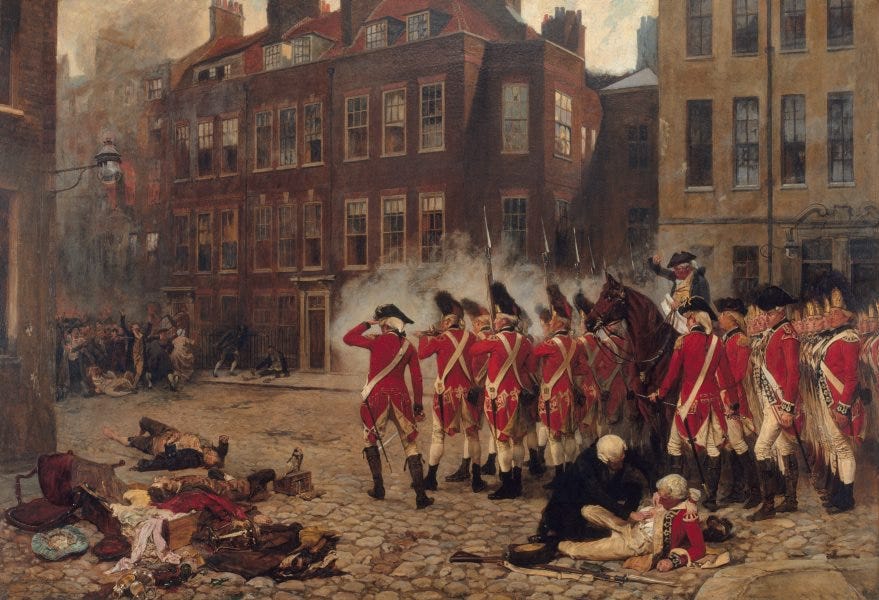
The Gordon Riots, 1780, painted by John Seymour in 1876, depicts the intervention of royal troops in the deadliest riot in British history. According to historians and the archival record, several Black Londoners took part in these grievance riots, and several were executed for their participation.
This short novel does a lot in its pages, but I want to dive into two intertwined aspects of the text that stood out to me: 1) the difficulties of Black life in London and the fragility of freedom, and 2) the complexity of Black British identity and the roots of diversity inherent to Black British identity.
Black in 18th-Century Britain
For most Black people in Britain at this time, poverty and race defined their existence. Historian and friend of mine, Dr. Tony Frazier, highlights that Black people in 18th-century London were “not only a race apart, but also a class apart,” with most occupying the most destitute of the city’s population. There were “free blacks, black runaways, domestic servants, footmen, prostitutes, musicians, apprentices, and sailors,” but any legitimate occupation existed under threat of loss at any time as a result of few protections. While Britain did not legally affirm the presence of slavery on its shores, Black domestic servants occupied a precarious positions, suffering volatile violence and little or no pay. All Black people teetered on the edge of capture and enslavement, which Martin highlights through a side character who is disgraced among his Black peers for selling himself into lifelong servitude to escape the harsh streets of London.
Martin draws from historical research to illustrate the harshness of London’s streets for the Black poor. He notes the rumors of Black people spreading disease through water, leading to bans on their access to wells and watering holes; the intentional hurling of insults and waste onto Black passersby; the sporadic violence that marked the time and left the Black poor vulnerable to attack; alongside the ease with which every gain could be lost in an instant. The fragility of Black freedom in the 18th century is summed up in an exchange between Buckram and Georgie George in the first chapter. After his release from prison and a night in the sick house, Buckram finds his old friend Georgie George and declares, “It feels good to be free again.” To which George responds, “Free? Free? We’re all in prison here, Buckie. You’re just out of geol (jail). But don’t forget you’re still in the exercise yard.” While Buckram’s later recollections of the racialized humiliations and tortures he suffered while in prison are truly hair-raising, Martin’s depiction of London proves George’s words of warning true. The violence, poverty, and humiliation that mark the lives of these men make Incomparable World a tough read, but also a historically accurate one.
Martin does not shy away from the complexities of Black positionality, allowing for seeming contradictions to coexist. While on one page we watch William make profits by dining and gambling with wealthier white men, using winnings to buy the latest fashions, on the next we see him hide these very same furnishings amidst a riot so as to not appear better off than the poor whites and incite racialized rage. While Buckram can face off with a white American slave owner in the street, refusing to assume the subservient position and even beating him in the presence of a cheering loyalist audience, we also see him fail to find legitimate work as the highly skilled horseman he is, on account of his race, forced into the illicit world of selling racist pornographic materials. Despite their skills being essential to the British during the war, none of these men were able to find the promised freedom on the soil of the nation supposedly “without slavery.” William, Buckram, and Georgie George serve as fictionalized versions of experiences that were a reality for countless Black poor throughout Britain’s past. Martin crafts these composite characters to tell stories that archival erasures do not allow historians to tell.
Multilayered Black British Identity
While Incomparable World centers on the lives of these Black American characters, Martin deftly highlights the multiplicity of Black identities and experiences that made up the Black population at the time. We meet wealthy, Black, English-born Charlotte Tell, an imagined character that points to the elite Africans who traveled to Britain for school and had families there; the learned Black abolitionists who keep her company; biracial children of African and English parentage; the African musicians who serve as “pampered regimental pets” in the British army; Caribbean and Americans who had escaped enslavement in the New World; alongside Indians and other peoples rendered subjects under British colonial expansion. Buckram notes this melee of Black peoples as he traversed Lisson Grove:
“The entire hamlet was full of poor, black men speaking strange English, and alien tongues. As well as African-looking people, there were members of East Indians and South Sea Islanders… a Mohawk.”
In the novel, and in reality, Black people in Britain at this time hailed from across the globe. None had the same origin story or heritage, and were bound together simply by the shared experience of being in the same place, in the same time, seeking a way to survive, or ideally, thrive. From the earliest years of a Black presence in Britain, the emerging Black British population has been something forged by shared futures, rather than a shared past. Martin nods to this, illuminating what, to this day, remains the heart of misunderstanding about Black British identity. Unlike other Black diasporic peoples who are bound together by shared histories and hard-won, diverse, and dynamic cultures, Black people in Britain in the 18th century, and still today, have vastly disparate origins. Some descended from enslaved or indentured Black people with longstanding roots in Britain, the Caribbean, or the Americas, while there are Africans who emigrated only a generation ago, or even more recently. Some fought for the British in both World Wars; others rebuilt the nation afterward; others simply arrived and survived the horrors of 17th- and 18th-century Black poverty. There is no single origin story.
As the metropole of countless Black nations across the world, Britain became the landing place and turnstile of Black people across time. To many people, this diverse heritage and lack of cohesion nullifies the veracity of “Black British” as an identity, but I believe the historical fact of this heterogenesis stretching back to the Roman era does not negate a Black British identity; it is simply a key feature of it. Immigration fundamentally creates a new people. While our heritage and home cultures will (and should) shape us, we cannot downplay the new cultures birthed out of being born and raised Black in Britain specifically. It is in those experiences, this shared present and shared future, that we find one another. There, we discover we are a we. There, our overlapping experiences, patterns of life, and intermingling cultures begin to birth something entirely its own: Black British.
Martin’s character Buckram imagines this future, stating:
Suddenly he was seized by a Delirious vision of this land, this London, in time to come, teaming with generation after generation of his kinfolk, freedmen, English-born and bred; transforming this wet cold land with African worship and celebration. Imperial orphans in communication with a fractured past- his present- leading Albion’s hag-masses to a greater, more wholesome dance of life. And would they, like him, still be hovering by closed doors, waiting for scraps from the Masters table? And would they, like him, still be able to rely on the kindnesses of curious suburban strangers?
Though fiction, Buckram’s vision rings true to our present. Much like those whose names we know, the nameless poor Blacks in Britain’s past knew that we would be here. They knew that fighting for abolition, for rights, for equality, was not just about their own lot, but about future generations they would never meet. Those who fought to survive 18th-century London did so with a “more wholesome dance of life” in mind. They imagined us, not with pasts erased but creating something new. They fought and hoped for more for us. Though they were few, and still we are relatively few today, they, and we, are a people formed by various threads woven into a vibrant tapestry of life. At the end of the novel, Georgie George, Buckram, and William choose to go their separate ways. But Buckram chooses to stay in London. This choice is foreshadowed by the vision of his descendants, and an earlier reflection:
This is home: London. This is my home: London. My friends are here. My life is here, and I live in this, our home: London town.
Without feeling at home, in the midst of maltreatment, Buckram still made home in London. Despite fraught relationships, he found his people, made family, and claimed London as his own. And while I wish there were a hundred more pages of this book, where we learn more of what his life became, his active choice to embrace a place that failed to embrace him back breathes a hope into his unwritten future and into ours
Thank you for reading, and I hope that you, like me, learned something new! Consider reading Incomparable World for yourself! It is definitely a worthwhile, and quick, read.
Coming Up
Next week, we will be fast-forwarding through time to explore the world of 19th Century Black Britons through The Fraud by Zadie Smith. I’m still reading this book, and it’s a trip. I can’t wait to share my thoughts, and I hope you’ll share yours.
Until then.