


Under the Rugs of British History
Welcome to the shifting sands of 20th-century Britain. A political union of four nations, a booming global empire (until halfway through), ravaged by two world wars, and rapidly changing socially and politically across the century. While this article will be focused on the 1940s, including the Second World War and its aftermath, through Small Island by Andrea Levy, it’s important to highlight these macro forces that this story is shaped by and play out in it.
I remember learning about the First and Second World Wars in school over multiple years and across several subjects. In English literature classes, we read Up the Line to Death, a phenomenal anthology of World War One poetry edited by Brian Gardner, featuring the work of tragic poets Siegfried Sassoon and Wilfred Owen, along with countless other former soldiers. Rendezvous with Death by Alan Seeger, which I first encountered at 14, remains a favorite and one I can still partially recite. In history, we studied the road to the First World War, and then spent several modules deeply studying 1930s Germany and the unfolding of the Second World War. All of this culminated in a trip to Berlin where we visited concentration camps, the grounding Holocaust memorial, and the Reichstag building. By the time I studied these topics at an undergraduate level, I truly thought there was nothing I didn’t know about this conflict.
However, in my late teens, my Trinidadian mother shared a memory of her uncle being courted by British officials to move to Britain to be a construction worker. A child in Trinidad at the time, my mum still remembers their suits, their accents, and their repeated visits to the house, asking again and again and promising a good life. My mum was born in 1957, so a while after the war, but my surprise led her to say, “You mean to tell me, you learned all about the war but not about Windrush?!” That’s when I first learned about the gaping hole in my education about the Second World War and its aftermath: I never learned anything about how these wars affected people in British colonies. Did any fight in the army? What happened to them if they did? What was it like? I learned from my Mum that there were Caribbean soldiers who fought, and that many returned to England — alongside thousands of others — at the request of the Queen, to rebuild the nation in disarray after the war. This generation of Caribbean immigrants is known as the Windrush Generation, named after the ship many of them arrived on in 1948. It is also the historical moment Andrea Levy explores in Small Island, our book for this week.
The Stories of Empire
Andrea Levy introduces us to the pre-, during, and postwar lives of Hortense and Gilbert, Jamaican’s in their early adulthood trying to build their futures; and Queenie and Bernard, a white English couple navigating the war as and the changing metropole of London. Moving backward and forward through time, Levy uses these varied vantage points to explore the British Empire and show how race and gender overlapped and clashed between Jamaica and England. Queenie, the daughter of a butcher, carves out an independent life by marrying Bernard, despite not loving him, and finds even greater autonomy when he departs for the war. Hortense, an ambitious and haughty teacher, similarly carves her path to the “Mother Country” by marrying Gilbert, despite knowing him for less than a week, to gain the freedom to leave Jamaica. Gilbert, an ever-determined former serviceman in the British Royal Air Force during the Second World War, strives to hold onto the hope of a better life in England than his tumultuous home life in Jamaica. This story tells many stories: empire and immigration, yes, but also changing identity, mid-20th-century womanhood, and the identity crises former soldiers face. For our purposes, I focused on Hortense and Gilbert’s immigration experience.
A refrain that came up again and again was Hortense and Gilbert’s references to Jamaica as a “small island.” Indeed, Jamaica is 1/22 of the size of the UK, so this is literally true. However, both Gilbert and Hortense use this phrase as if it holds more meaning than the island's literal square footage. For Hortense and Gilbert, the island’s smallness represents, at best, the limits of their ambitions and, at worst, their internalized sense of inadequacy and irrelevance shaped by the colonial narrative crafted by Britain. Gilbert and Hortense don’t see moving to the UK as an exciting opportunity; they see it as an essential step toward upward mobility. Throughout the narrative, we learn this isn’t an organic opinion, but the product of generations of British propaganda. After Gilbert declares to a confused white British man that he “wanted to fight for his country,” he goes on to reflect to the reader:
Let me ask you to imagine this. Living far from you is a beloved relation whom you have never met. Yet this relation is so dear a kin she is known as Mother. Your own mummy talks of Mother all the time. “Oh Mother is a beautiful woman — refined, mannerly, and cultured.” Your daddy tells you, “Mother thinks of you as her children; like the Lord above she takes care of you from afar.” There are many valorous stories told of her, which enthrall grown men as well as children. Her photographs are cherished, pinned in your own family album to be admired over and over. Your finest, your best, and everything you have that is worthy is sent to Mother as gifts. And on her birthday you sing-song and party.
Britain promulgated this ideology of itself as a benevolent power, deserving of Jamaica’s best. Indeed, this idea is as old as Britain’s claiming of Caribbean islands in the 16th century, when enslaved Africans were imported by the British, toiled and died, harvesting the sugar that would be exported to create the luxuries the British enjoyed, like chocolate. Britain and its colonies had long maintained an extractive relationship, but by the mid-20th century, they extracted Caribbean people themselves. Not only did Britain rely on tens of thousands of soldiers from its colonies to fight in both World Wars, but Britain also invited Caribbeans to emigrate to the UK to rebuild the nation after the Blitz had destroyed many of its cities. In exchange for permanent residency (later denied—learn about the Windrush Scandal here) and employment, Britain invited thousands from across the Commonwealth to immigrate to its shores.
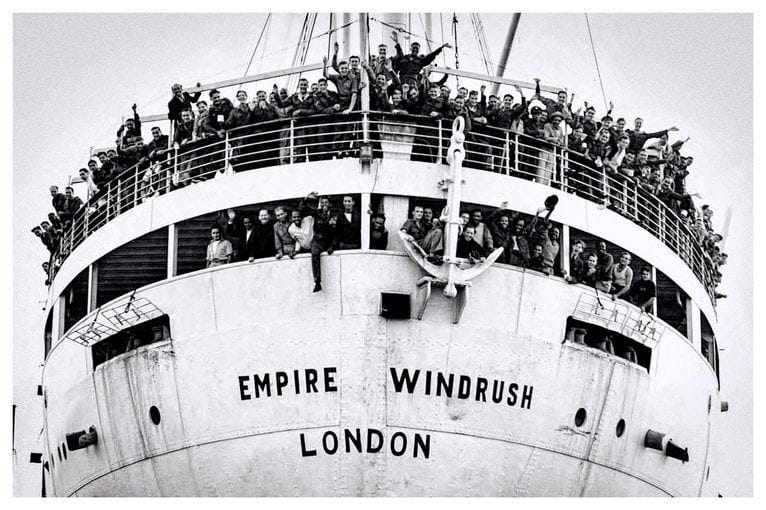
The HMT Empire Windrush is the name of the famed ship that brought roughly 800 Caribbeans to the UK in 1947. This became the known marker of the generation of Caribbean and other Commonwealth migrants to the UK in the post-World War Two era. Accessed via: English Heritage
Between this long-established idea of Britain as “Mother Country” and this invitation, it is clear that Gilbert, Hortense, and their very real historical counterparts understood themselves as truly a part of Britain. Their Black British identity was taught. They believed they belonged and would be welcomed by the nation. And why would they not? How could they not? Understanding this makes sense of the depths of disappointment they experience when they find Britain hostile to them and indifferent to their survival. Gilbert continues to reflect on this, saying:
Then one day you hear Mother calling - she is troubled, she need your help. Your mummy, your daddy say go. Leave home, leave familiar, leave love. Travel seas with waves that swell as concrete buildings. Shiver, tire, hunger — for no sacrifice is too much to see you at Mother’s needy side. This surely is adventure. After all you have heard, can you imagine, can you believe, soon, soon, you will meet Mother?
The filthy tramp that eventually greets you is she. Ragged, old and dusty as the long dead. Mother has a blackened eye, bad breath, and one lone tooth that waves in her head when she speaks. Can this be that fabled relation you heard so much of? This twisted-crooked weary woman. This stinking cantankerous hag. She offers you no comfort after your journey. No smile. No welcome. Yet she looks down at you through lordly eyes and says, “Who the bloody hell are you?”
A Mother typically claims her “children” (an, of course, paternalistic and problematic framing), yet Britain denied them, and Gilbert learns that most British people have no idea where Jamaica is, no respect for it, and no interest in their wellbeing. They quickly piece together that though they have been taught to laud the British, they find very few reasons to do so. This resonates with my Mum’s experience. She grew up similarly wrapped in stories about Britain, to the point that, when considering her ambitions and desire to support her family, Britain was the only place she considered moving to. Anywhere else would have felt like a betrayal. Yet she also remembers the disappointment of what she found: less-trained people preferred over her; being denied opportunities to practice and learn more as a nurse; always ending up on bedpan duty; navigating patients’ refusal to let her touch them; and so much more.
Black British Identity Has International Roots
Small Island has many layers to examine, and so it’s a struggle to stop here. But I highlight this dynamic because it matters to our understanding of Black British identity. Black British as a national identity marker is often questioned or denied, and yet, we can see that any concept of Black British was first manufactured by the metropole, and only became questionable when the supposed “children” of empire began claiming their place. When people from across former colonies began moving to the UK, the idea of a Black British identity, and of any kind of belonging and true equal citizenship, dissipated. But whether given or not, generations of people across the Commonwealth fought for independence and for recognition of their essential contributions to Britain’s wealth, and countless claimed their place in British soil as theirs, too.
To me, these international roots of Black British identity tell the story of why many of us came to the UK in the first place. Small Island illuminates the unique positionality of Commonwealth people and their relationship to Britain. Amid the hardship and uphill climb Hortense and Gilbert face in building a life, they claimed Britain as their birthright, an outcome Britain did not expect. Black British people have been such and with more layers of identity than we have been permitted to claim, and Small Island might leave you with similar musings and questions about who gets to call themselves British.