


In my experience, Black British history in the 19th century is entirely outsourced to Caribbean history. Although the British Caribbean was integral to the British Empire until the independence gains of the 20th century, British history often skips over the Transatlantic Slave Trade and instead focuses on the success of William Wilberforce’s abolitionist campaign. We skip over the violent institution of slavery established for centuries across the Caribbean, at the hands of British slavers and landowners, but celebrate ourselves as one of the first emancipators in the New World. Zadie Smith highlights the integral nature of Britain’s empire, not just to Britain’s history, but to its day-to-day functioning. The Fraud turns the lens upon the British to illuminate the embeddedness of slavery in the racial and gendered hierarchy on British soil, ripping off the mask of Britain’s history.
The Plot
The Fraud imagines the life of historical figure Mrs Eliza Touchet, the brusque Scottish cousin and housekeeper of famed author William Ainsworth, as she navigates spinsterhood. Although Mrs. Touchet married young, her husband quickly abandoned her for unknown reasons and passed away soon after, leaving her only £100 per annum- a very modest living. William Ainsworth, her husband’s cousin, agrees to take her into his family home where she earns her keep as his housekeeper and confidant. Flashing backward and forward through time, between the 1870s and 1830s, Smith reveals the shifting world of 19th-century London through Touchet’s eyes. She is a smart woman with staunch moral convictions that earn her the nickname “the targe,” yet she feels hindered and sidelined on account of her sex and social standing. Nonetheless, through her cousin, Touchet is immersed in the 19th-century literary world, and through her growing interest in the court case of the century, she begins to learn that the freedom she so covets may have been closer than she allowed herself to see.
Now, I am sure you are wondering what this woman’s story has to do with Black British history, and for a while so did I. The book is incredibly fast-paced as it is written in the style of Victorian newspaper serials- think Charles Dickens publishing Oliver Twist in a monthly paper- but it is also written in the Dickensian style with multiple layers of relevance within the text. On the surface, we follow Mrs Touchet’s life and meet the winsome, frustrating, and comical characters in her life, seeing the intersections between gender and class. However, on the next level, we find the book’s racial subtext. While race and Black characters feel tangential to the plot- asides between characters about the institution of slavery, Touchet’s growing abolitionist sentiments, and background characters of Black domestic servants- Smith is doing a lot more than immediately meets the eye.
We learn about slave revolts in Jamaica, rebellions by freedpeople denied justice and basic provisions by the colonial government, and the biracial abolitionist Robert Wedderburn’s fiery speeches in Parliament. Through these seemingly peripheral events and figures, Smith actually points to the simultaneous essentiality and erasure of Black people in 19th-century Britain. Tucked thoroughly into the vantage point of a white middle-class woman, the engine that keeps her world turning is, very apparently, the work of the enslaved and, eventually, freed people. Through this, Smith argues that it is not simply that we have forgotten or erased Black people in the historical narrative in hindsight; through The Fraud, Smith shows us that that erasure is long-standing: those who lived at the time ignored the reality of just how essential enslavement was to their society. Those living at the time ignored the lives of Black people at home and across the Empire, never really seeing them as anything more than accessories and bystanders, rather than the power that fueled the engine of British wealth and society.
One Story Tells All
This comes into stark relief in the second half of the book, where we meet formerly enslaved man: Andrew Bogle. Throughout the book, Touchet and her cousin’s second wife, former servant Sarah, become enthralled by the Tichbourne Trial, a fraud case that filled newspapers in the 1860s. In this dramatic court case, an Australian man named Arthur Orton claimed to be the lost-at-sea baronet Sir Roger Tichbourne. Sarah and countless others believe Arthur Orton’s story and follow the case closely, hoping for his innocence, but Eliza becomes captivated with Andrew Bogle- a key witness in Orton’s defense. A formerly enslaved man from Jamaica, Bogle claimed that Orton was indeed the long-lost Tichborne, believing that he remembered him as the nephew of his former enslaver Sir Edward Doughty Tichborne. Although he had not seen him in decades, Bogle, then in Australia, allegedly bumped into Orton and immediately recognized him as Tichborne.
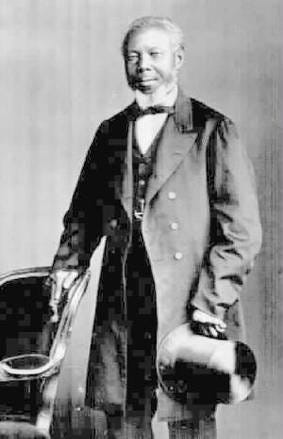
Andrew Bogle, accessed via: Jamaica History
Upon hearing Bogle’s testimony, Eliza Touchet was captivated and pursued Bogle to learn more of his story. Through Bogle, everything suppressed in the first half of the book bursts into the foreground. Through his willingness to speak with Eliza, we learn of the horrors of enslavement on the Hope Estate in St. Andrews, Jamaica. We see all he loved and lost, his heritage and dreams for himself, and Eliza is forced to behold his wholeness and humanity. These chapters were my favorite, as Smith paints a rich portrait not just of slavery as an experience, but of Bogle’s life as three-dimensional, worthy of attention, and worthy of grief. Bogle’s personhood erases Eliza’s borders of understanding, forcing her to acknowledge that her life and his were inextricably linked. Through this brief relationship, Smith seems to show how obvious these ties are once you take the time to look. At the same time, these ties run beneath the surface of the whole book, through which she also seems to highlight how systems and society have hidden the truths of Black history in plain sight. Black history is there for those willing to look closely, but how many people will?
Touchet’s awakening disturbs her sensibilities and vision of the world, leading her to question everything she had once believed about herself and the nation she calls home. This unraveling comes to a head in a short chapter called Theory:
Mrs. Touchet had a theory. England was not a real place at all. England was an elaborate alibi. Nothing real happened in England, only dinner parties, boarding schools, and bankcrupcies. Everything else, everything the English really did and really wanted- everything they desired, and took, and used, and discarded- all of that, they did elsewhere.
This chapter stuck with me precisely because it’s clear truth. The very fact of Britain’s Empire being on distant shores, inhabited by people who do not reflect the majority population in Britain, has simultaneously allowed Britain to claim its successes while obfuscating the harm, violence, and exploitation that it wreaks. In a way, The Fraud suggests that Britain functions as an offshore account into which the spoils are deposited with no trace of their origins. This separation is precisely what made, and continues to make, Black history easy to ignore and erase in the British narrative. Yet, Smith proves that the archives are full of this history, with people, events, and stories that are all a part of the tapestry of British history. Smith uncovers the many layers of power and subjugation in Britain, showing how gender, sexuality, class, and race intersected in 19th-century England.
While it took a long time to warm up to this book, I now realize some of my apprehension came from being inundated with information I felt I should have known but didn't. This lack intimidated me, as I had to keep looking up people and historical events. But the more I dug into the story, the more I realized that Smith intentionally juxtaposes our ignorance with the common knowledge of these historical figures, showing us the gaps in the British story that were known but relatively unexamined then, and are ignored now. If you choose to read The Fraud you will leave with a treasure trove of topics you want to learn about, and, to me, that’s the best thing historical fiction can do for us.
Coming up
We will move on to the 20th century later this week through Small Island by Andrea Levy! I’m looking forward to learning more about the Windrush generation and sharing what I learn with you!
Thanks for reading, and as usual, please share anything new that you learned from these reflections in conversation with me below.