


With the well-deserved Oscar wins of Ryan Coogler’s movie SINNERS, I am reflecting once again on its storytelling brilliance and its incisive examination of many of the central themes of Black history in the US. Through the unlikely genre of vampire horror, Coogler illuminates threads of Black liberation, creativity, and survival amid white supremacy. Yet, at the time, many Christians, Black and white alike, either refused to watch it or regretted watching it, interpreting it as “anti-Christian propaganda.” At the time, I saw this as an error and wrote about why for Common Good Magazine. Almost a year later, I stand by my call to read art (cinema, literature, and everything in between) with a lot more curiosity and fearlessness. In fact, I am more convinced that the matter of Christian responses to art warrants deeper interrogation and correction.
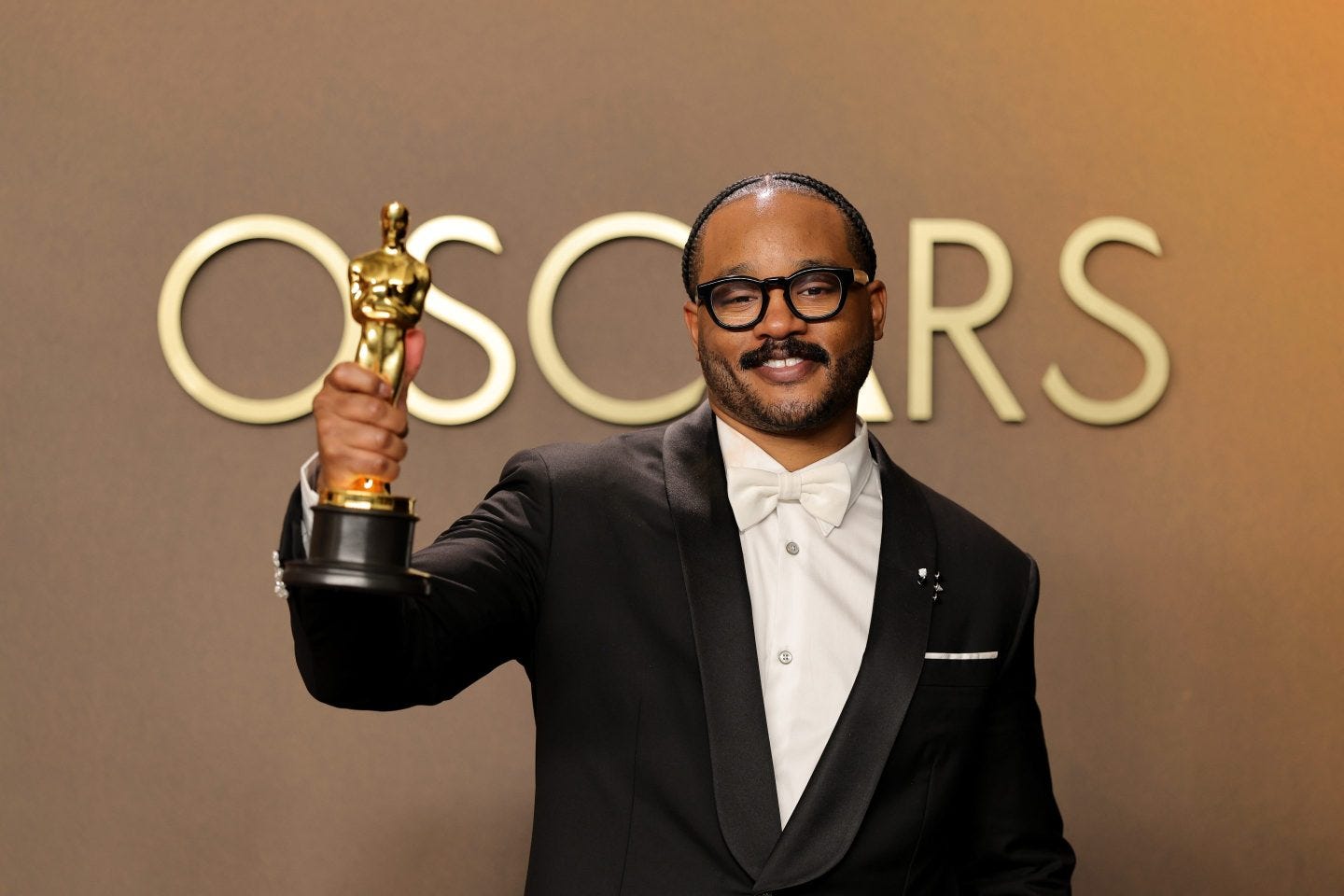
Ryan Coogler, Brianna Bryson / Fortune Magazine Staff / Getty Images, accessed via: Fortune Media
So, I’m sharing it with you all here for you to read and consider. I loved writing this, and I hope you enjoy it and are challenged by it.
‘Anti-Christian Propaganda’? An Alternative Review of ‘Sinners’
This spring, Ryan Coogler’s SINNERS set a fire in the world of cinema, igniting social discourse around Black film, vampire lore, and American history. Unsurprisingly, the provocatively named movie quickly became a source of Christian cultural conversation, and notably managed to elicit the label of “anti-Christian propaganda” by rapper Lecrae and countless others who disliked the way the movie portrayed our faith. In an interview with TMZ, Lecrae argued that SINNERS is a “beautiful piece of work” with masterful visuals and storytelling, but he felt it portrayed Christianity as “oppressive and irrelevant.” He went on to lament the entanglement of Christianity and colonization in modern secular thought, arguing that its use as a tool of oppression “does not discount its relevance, its power, its potency.” He then reminded listeners that Christianity did not originate in Europe, but rather reached Africa first, a fact that remains relatively unknown. It has been two months, and the fire of this conversation has died down a little, yet, as a Christian, lover of art, and a historian, offering an alternative way of thinking about SINNERS, and art more generally, feels necessary and (hopefully) useful.
While Lecrae highlights the potency and power of Christianity and its Eastern origins, there are two main flaws in his argument. First, his response does not speak directly to the tangled history of Christianity and colonialism; it speaks past it. Despite the origins of Christianity, it remains that countless Western empires used it as a tool of oppression across the globe, and in particular used Scripture to endorse chattel slavery as biblical and a positive good. Secondly, to conclude that SINNERS is “anti-Christian propaganda” is a reaction symptomatic of the lost art of storytelling and story exploring in broader Christian culture. In a moment when surveys report the supposed decline of Christianity in America, it is easier to lament any narrative that alludes to some of the harsh realities of American and Christian history, seeing it as an attack on the faith. But reading stories well requires us to engage from a place of confidence, with curiosity rather than judgment.
To examine the presentation of Christianity in SINNERS in good faith is to engage the history of Christianity in America and the broader Western world. In the film, Coogler pulls on the connecting thread between African American and Irish experiences of Christianity. It is a climactic and haunting moment between the musician and pastor’s son, Sammy, and the leading vampire, Remmick, wherein the latter joins Sammy in his recitation of the Lord’s Prayer. Instead of cowering under the words of Scripture, the vampire informs Sammy that colonizers used Christianity to subjugate and brutalize his ancestors, just as enslavers had done to Sammy and his. Not only are the words familiar to him, but they appear to be powerless to defeat him. Two symbols coincide: the proverbial devil himself, uttering Scripture as he did to Jesus in the wilderness, and, the white vampire who means to feed on Sammy, evokes the slaveholders and slaveholding system that fed on the bodies of Sammy’s near family ancestors while co-opting Scripture to encourage their submission.
This moment elicits a sense of utter helplessness for Sammy and for any viewer who understands that what was said is historically accurate. Indeed, English colonizers used Protestantism as a tool to oppress Irish Catholics as early as the 16th century, causing religious violence that has marked each subsequent century. Similarly, European settlers crafted theologies of “Manifest Destiny” to permit the colonization and extermination of Native Americans, and pro-slavery theology to sanctify chattel slavery and white superiority as God’s created order. In both cases, Christianity did not merely coexist alongside colonialization and enslavement in the Americas; colonizers and enslavers actively weaponized the faith against those they desired to subjugate. Thus, the moment between Sammy and Remmick points to centuries of misuse of Scripture that led to the inconceivable harm of millions.
Engaging the faith of the enslaved is the only way to respond directly to the conundrum SINNERS presents. Rather than circumvent or defend the Christianity that endorsed slavery, we can find the potency and power of Christ in those who critiqued and challenged injustice and the misuse of God’s Word in American history. In both trade with and enslavement of Africans, Europeans used Christianity as a bargaining chip and tool of subjugation, yet, countless enslaved people chose Christianity for themselves before slavery’s end. This is evident in the mass conversions of the First and Second Great Awakenings in the 18th and 19th centuries, which birthed traditional evangelicals who “sought to include every person in conversion, regardless of gender, race, and status” without challenging the institution of slavery. Despite this, enslaved converts to Christianity saw the incongruity of slavery with the faith, seeking freedom for themselves and adopting abolitionist positions, a trend that can be seen in conversion narratives of formerly enslaved people.
Richard Allen, the founder of the African Methodist Episcopal Church, wrote that his conversion led him to be more industrious in his enslavement until he could purchase his freedom, which appears, at face value, to affirm Christianity as an oppressive tool. Yet, later in his narrative, in an address “To the People of Color,” Allen expresses empathy with the still enslaved, stating that when enslaved he was “as desirous of freedom as any of you, yet the bands of bondage were so strong that no way appeared for my release,” which reveals that his continued conscientious labors did not come from an endorsement of slavery, but from lacking a means of escape. After obtaining his freedom, Allen condemned the institution of slavery on religious grounds for the rest of his life. In the early 1780s Allen and other free Blacks attended St. George’s Church in Philadelphia, a white Methodist church, until they refused to accept second-class membership. First, St. George’s clergy forced Black congregants to receive communion after all white congregants, a practice Allen and his counterparts deemed deeply contradictory to the Gospel of Christ. Then, the clergy created segregated seating, forcing Black congregants to move to the back of the church, mostly to standing positions. This led to a Black congregational “sit-in” led by Allen and Absalom Jones, where they refused to voluntarily move from their chosen seats in the sanctuary, leading to their forcible removal by white clergy who would not allow them to kneel in place for prayer. In their rebellion, Allen states, “the Lord was with us,” allowing them to raise funds to found the A.M.E Church where Black Philadelphians could worship freely. Allen denounced slavery and white supremacy in word and deed. In a section entitled “An Address to Those Who Keep Slaves and Approve Its Practice,” Allen compared America to Egypt, encouraging white Christians to “consider how hateful slavery is, in the sight of that God who hath destroyed kings and princes, for their oppression of the poor slaves.”
Similarly, Christians who engaged in the Black Jeremiad tradition not only rejected pro-slavery theology, but they also prophesied God’s coming judgment against American slavery. For example, Black abolitionist writer David Walker wrote in his famous 1829 pamphlet “An Appeal, in Four Articles,” that “the God of the Etheopeans, has been pleased to hear our moans in consequence of oppression; and the day of our redemption from abject wretchedness draweth near…” He denounced the “inhumane institution of slavery,” and declared that God, “being a just and holy Being,” would “one day appear fully in behalf of the oppressed, and arrest the progress of the avaricious oppressors.” Walker prophesied that “the destruction of the oppressors” God may not achieve by the hands of the enslaved, “yet the Lord our God will bring other destructions upon them…” Other Black Christian abolitionists continued these prophetic warnings throughout the antebellum era, and the enslaved themselves told of their sustained prayers for a Moses figure- often seen as Lincoln in the Civil War years- to lead them out of their captivity. These deep convictions and prophetic voices among literate and illiterate Black people of the antebellum era demonstrate the undeniable potency of God’s power to reach and empower the enslaved and abolitionists.
Further, confronting the legacy of slavery and Christianity requires us to denounce the legitimacy of slaveholding Christianity. Formerly enslaved man and abolitionist Frederick Douglass exemplified this in his speech responding to those who accused him of apostasy. He stated: ““What I have said respecting and against religion, I mean strictly to apply to the slaveholding religion of this land, and with no possible reference to Christianity proper; for, between the Christianity of this land, and the Christianity of Christ, I recognize the widest possible difference—so wide, that to receive the one as good, pure, and holy, is of necessity to reject the other as bad, corrupt, and wicked. To be the friend of the one, it is of necessity to be the enemy of the other.” I encourage us to follow Douglass’s lead. Rather than attempting to sanctify and sanitize the history of slaveholding and Christianity, to champion the Gospel, we must learn from those whose faith, actions, and speech align with God’s Word, and reject any changed version of the Gospel. While these truths do not undo the weaponization of Christianity by unjust systems, they allow us to tell a more whole and beautiful story in which God is bigger than His creation; His power and might are not tied to the faithfulness of the powerful.
Engaging Story Well
SINNERS is not, by any stretch, a Christian story, but I do want to leave us with an alternative way of engaging this story, as an invitation into how we can learn, and be challenged by, secular art in all forms. My approach to art— whether film, literature, music, or other forms —is best summed up by literary professor and writer Karen Swallow Prior. In the opening pages of On Reading Well, Prior reflects on the way “reading widely, voraciously, and indiscriminately” allowed her to learn spiritual, emotional, and intellectual lessons that she “would never have encountered within the realm of her lived experience.” The result: learning “how to be the person God created me to be.” This, surprisingly, remains true, even in my viewing of this contemporary vampire horror movie. Here are a few reflections SINNERS led me to:
Blackness is often portrayed as incongruous with Christianity, becoming an obstacle to many.
The character Sammy, a gifted musician, is presented with a false binary by his preacher father: give up playing music and be saved, or keep playing the Blues and be damned forever. This plot line reflects historical truth, as many Christian communities have deemed Blues music as demonic throughout time. But it also reflects a common experience among Black Christians who have felt implicitly, or been told explicitly, that their faith requires a shedding of most Black identity markers. Rather than an invitation to the reformation of cultural practices (Sammy’s father could have questioned the environment Sammy played in, rather than his gifting and passion), many are faced with the same false binary today. Sammy’s conundrum reminds me of Jemar Tisby’s extensive speaking and writing on the direct correlation between his activism to remedy racial injustice, a central reality in the Black experience, and being maligned in the circles in which he used to be welcome. It reminded me of my journey from discomfort to comfort in the body and cultural heritage ordained for me, and to seeing and celebrating the beauty in different cultures and communities.
God was gracious anyway.
The film makes it clear that Sammy, presented with this binary, chose the Blues. He chose to defy his father by playing at the juke joint and indulging in all it had to offer, ultimately embroiling himself in the waking nightmare of vampire attacks. While Sammy’s choice led to these harrowing consequences, his life is, unexpectedly, spared. He is the only survivor, left to stumble back to his father’s church, where he is presented with the same choice again. The survival of Sammy pointed me to the truth that the consequences of our choices are often still covered by God’s grace, and our deserving lies far outside the scope of God’s actions.
Sometimes deliverance is simply the rising of a new day.
Sammy’s survival did not come from a death blow he dealt, but rather from the rising of the sun. Indeed, the sun, the morning, the next day came for Sammy, just as it seemed Remmick would win. Just as it seemed Sammy’s prayer was useless and God was silent. This led me to reflect on the way we often seek a dramatic intervention of the power of God, to supernaturally defeat evil. But often, deliverance looks like the dawning of a new day, with new mercy. In my battles walking with God through chronic illness, the rising sun of deliverance has looked like strength for today and bright hope for tomorrow; the answering of some prayers amidst the waiting for others; God’s giving me eyes to see more joy than I could before. On a larger scale, the coming of the dawn in the perfect moment for Sammy reminded me that God’s will, goodness, and grace stand above and beyond our understanding of Him, and even our submission to Him, because He’s just that good.
Our responses to art are often unique to our circumstances, positionality in the world, and our systems of belief– meaning, we will all interpret a loaded piece like SINNERS differently, no matter Ryan Coogler’s intentions. This is part of the beauty of storytelling: that while there is the writer’s intended meaning, engaged audiences can draw out even more. However, when we engage storytelling from a perspective of the fragility of Christianity in the modern world, we risk perceiving most expressions of the human experience and history as dangerous, rather than something to interrogate and thoughtfully engage. Instead, I invite us to engage storytelling from the solid ground of God’s final victory. Then, and only then, will we be free to engage stories well and adequately respond to the tangled history of race, Christianity, and colonization.
©2026 Abena Ansah-Wright. Originally published in Common Good magazine.
If you are not already subscribed to Common Good Magazine, you should definitely consider doing so! Their issues include topics such as this, as well as theology, economics, vocation, arts and culture. Subscribe here.